AQ2XL-RAD
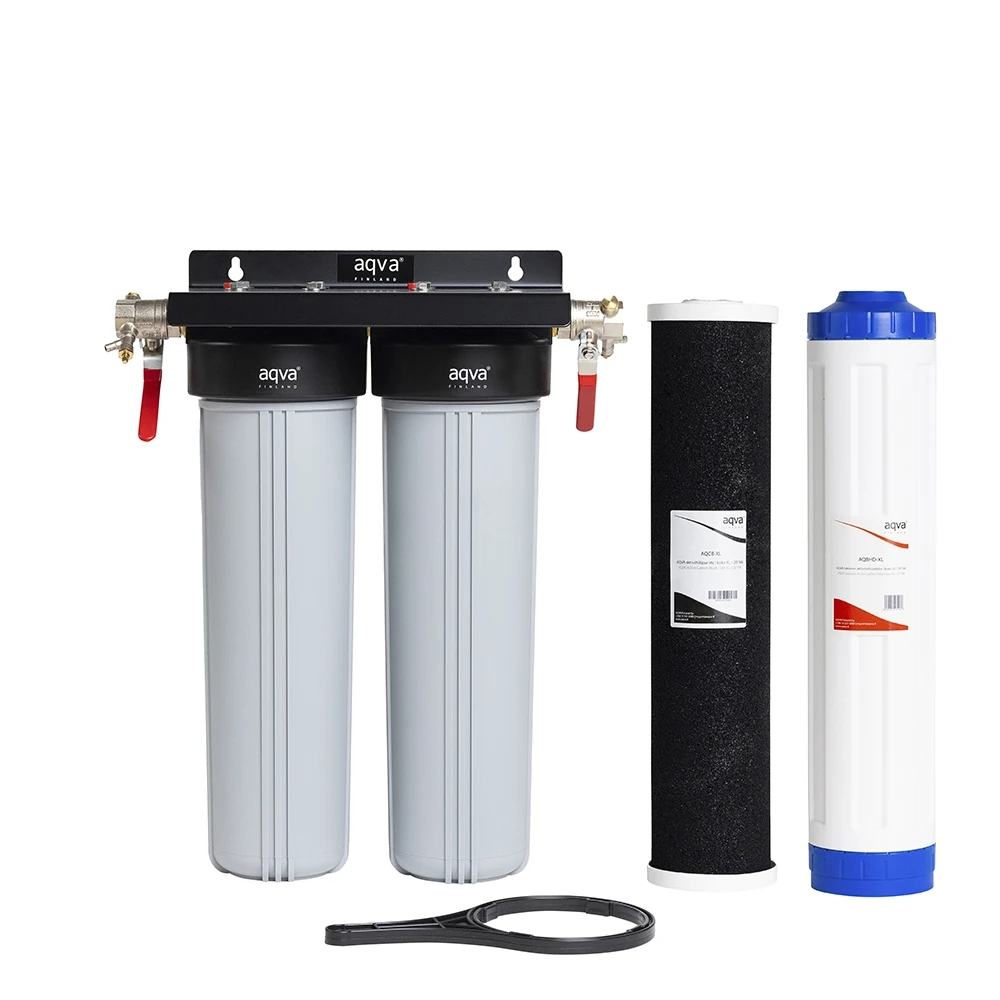
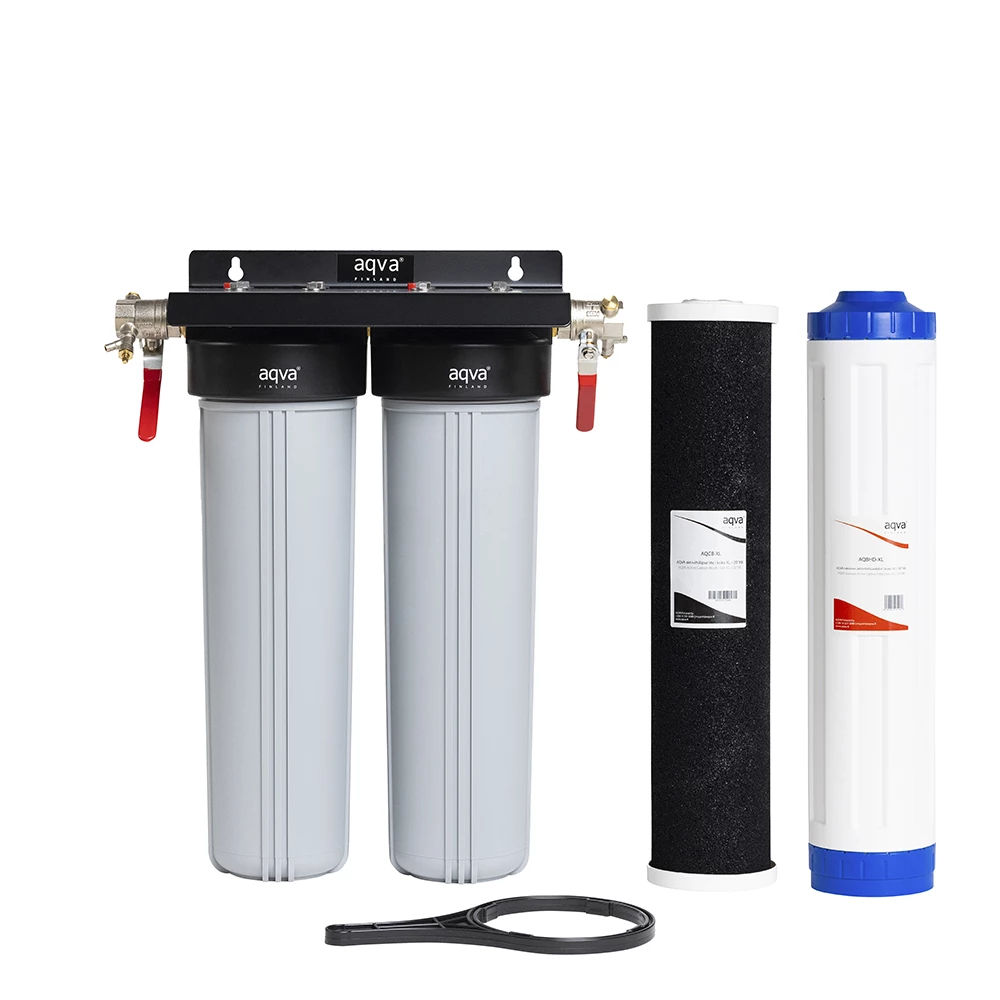
AQVA XL / 20" BB filter combination - radon
350,00 €Sis. alv 25.5%
9 pcs available immediately
Tilaa saapumisilmoitus sähköpostiisi, niin saat heti tiedon kun tuotetta on jälleen saatavilla.
Katso toimituskulutAlk. 7,89 €
Testatusti toimiva
Lähetys 1-3 arkipäivässä
14 päivän palautusoikeus
Kuvaus
Activated Carbon Filter Package for Radon Removal from Household Water
Activated carbon has traditionally been used for filtering radon from water due to its excellent binding capacity. The type and quality of the water affect the binding efficiency, so AQVA's packages combine different types of activated carbon to maximize effectiveness. They include granular activated carbon and granular activated carbon in bituminous compressed form, which also filters solids and sediment down to a 10µm particle size.
In activated carbon filtration, radon-contaminated water is passed through an activated carbon bed, where the radon binds to the activated carbon. After commissioning, the activated carbon filter reaches an equilibrium state in a few weeks, at which point the bound radon decays at the same rate as new radon binds. After this, the filter's radon removal capacity is primarily reduced by other water impurities, which consume the activated carbon's lifespan or efficiency.
Maximum radon level for the filter unit: 3000 Bq/l.
Benefits:
- Improves the quality of utility water
- Effortless maintenance
- No drainage required
- Pressure release button
- Standard size category 20" BB
- Easy to install and use
- No electricity needed
Technical Specifications:
- 1-inch internal brass-reinforced connections
- Dimensions: Height 630 mm, width 500 mm, depth 200 mm
- Dry weight approx. 10 kg
- Refer to the user manual, which can be found on the "Files" tab
System Requirements:
- Typical flow rate under 15 liters per minute
- Steady supply pressure 2-10 bar
- Filters are installed in the water line after the membrane pressure tank
- Operating temperature 2-30 °C
- Recommended filter replacement interval 6-12 months. We recommend monitoring radon levels with regular water analyses. Water quality and other impurities may affect the filters' lifespan.
Filters:
- Radon
- Hydrogen sulfide
- Odors and tastes
- Heavy metals
- Chlorine
- Pesticides
Package Contents:
- Filter housings
- 1" Nipples for connecting the housings
- Sampling ball shut-off valves (with space for a 1/4" threaded pressure gauge AQ-PG15-14 sold separately)
- Housing wrench
- Wall mounting bracket
- Filter cartridges AQCB-XL and AQBHD-XL
Special Considerations Related to Activated Carbon Filtration:
- It is important to note that the filter becomes a radiation source because the decay products of the retained radon produce gamma radiation. However, this can be addressed with fairly simple measures: Place the filter in spaces where people do not spend time and where the filter cannot cause radiation exposure, such as a basement or a space separate from living areas with functional ventilation. The Radiation and Nuclear Safety Authority recommends placing the activated carbon filter in a completely separate building or well maintenance space if available. You can also shield the filters with a steel plate, which reduces the filters' radiation. Steel is recommended as a material, although lead could enable about a 30% lighter structure, but if used incorrectly, it can be harmful to humans.
- The placement of the activated carbon filter can be easily assessed based on the following "Radon Flux" calculation formula: Radon flux is the raw water radon concentration multiplied by daily water consumption. The average resident uses 140 liters of water per day. Thus, for a family of five with 2000 Bq/l radon in the water, the radon flux is 5 × 140 l/day × 2000 Bq/l = 1.4 MBq/day.
- If the activated carbon filter's radon flux is greater than 1 MBq/day, the filter must be equipped with radiation shielding.
- Additionally: In buildings where partition walls are made of light materials (e.g., wood or gypsum board), the filter must be located at least 8 meters from a living room or 2 meters from a utility space.
- After decommissioning the filter, it takes about 3 weeks for the dose rate from the filter's radiation to decrease to background radiation levels.
- When installing the activated carbon filter, consider the uranium content in the water. If uranium exceeds 100 µg/l, uranium must be removed from the water before the activated carbon filter. Uranium reduces the activated carbon's radon removal capacity.
- Other water quality characteristics, such as high humus content, metals, or bacteria, can also impair radon removal capacity. Contact AQVA's advisory service, where we can check the suitability of the water quality or the need for additional filtration.
- The radon concentration and overall quality of the treated water should be monitored at regular intervals with laboratory analyses!
Winter Storage:
- In winter, if temperatures drop below 2°C, to prevent frost damage, the water lines must be closed and the inline filter housings drained of water. The filter cartridges should be stored in a warm space.
Tiedostot
Arvostelut
Kysymyksiä
Suomalainen verkkokauppa
Verkkokaupallemme on myönnetty Avainlippu-merkki. Verkkokauppaa pitää yllä suomalainen yritys, joka toimittaa tuotteet Suomesta. Myös monilla tuotteillamme on Avainlippu-merkki.