Shower filter protects hair from chlorine and metal accumulation

A shower filter is recommended by an expert hairdresser
Hair becomes tangled, breaks, turns yellow and green. You spend money on hair care products and salons, but they only help for a short while. Does this sound familiar? The root of the problem may be in a surprising place: your shower. Tap water can contain metals and chlorine, which discolor and dry out your hair with every wash.
Few Finns associate their hair problems with showering, even though tangles, dryness, and color defects caused by metal and chlorine residues are surprisingly common. We interviewed hair professional and founder of Folk Helsinki , Meeri Mäntylä, about the topic.
“Every hairdresser knows how metal deposits affect the health of hair and the results of dyeing. Color defects caused by water pipes are a daily topic of discussion in our hair salon,” says Mäntylä.
Deep cleansing and color-maintaining products alone cannot fix the problem, as metal accumulates in the hair with every wash. Often, the problem only disappears completely when a shower filter is added to the shower to filter out metal, limescale, and chlorine residues.

- Meeri Mäntylä, Folk Hairdressers
Is our tap water not as clean as we thought?
Even if the tap water itself is of good quality, metals and iron can leach into the water from the pipes. Metals weaken and discolor, especially blonde and processed hair; porous and blonde hair acts like a sponge. Disinfectants and pH adjusters added to the water at water treatment plants, such as chlorine, dry out the skin, scalp and hair. Dry skin caused by chlorine is especially common among atopic dermatitis sufferers.
The metal content is visible in the hair as a greenish or yellowness, and in addition, the metal washes out the new hair color faster than usual. Hairdressers are also familiar with the phenomenon where hair that is being bleached swells or overheats in the foil: “When hydrogen peroxide meets metal, the hair reacts by swelling and heating up. Therefore, it would be a good idea to remove the metal from the hair before bleaching,” Mäntylä advises.
According to Mäntylä, even dark-haired women are not spared from the harmful effects of metal. “You can tell that metal is present in dark hair by the fact that it feels lumpy, tangled and woody. Especially when wet, hair can be in a shocking state.”
Why is there so little talk about this topic?
Mäntylä and his colleagues hope that the issue will become more widely known among Finns. Many people's skin and hair problems would be solved if a shower filter filtered out excess impurities from the water. "It's not about the water, it's about the plumbing. Even in a new house, there may be an old main pipe from which metal is coming off."
“Currently, the solution to the problem is limited to hair salons selling customers metal-removing shampoo. Shampoo alone is not necessarily enough to solve the problem. Instead of just using care products, we should get to the root cause, i.e. impurities in tap water. That is why shower filters are part of the standard selection at Folk hair salons,” says Mäntylä.
How to avoid hair problems caused by plumbing
The first step is to get rid of old metal buildup. Mäntylä recommends a metal removal treatment at a hair salon, which will leave your hair feeling softer and looking brighter.
“Metal-binding shampoos that can be purchased at home can also help, but they certainly don't eliminate the problem completely.” After the metal removal treatment, Mäntylä recommends an AQVA shower filter, which filters excess metals, limescale, and chlorine from the wash water.
“A shower filter ensures that no more metal accumulates in the hair in the future.”
Mäntylä emphasizes the importance of common sense, home care and scalp health in hair care: “Only a healthy scalp can grow healthy hair. It is worth protecting your scalp and hair from the sun, seawater and hot appliances. If your scalp is flaking, it needs your attention. If the skin on your face is flaking, most people try to take care of it. The same should be done for your scalp.”
Shower filter at home – do you really notice a difference in the water?
The best person to answer this question is someone who has been using a shower filter for a long time. We interviewed Sirja Pasa, who bought her first filters for her home back in 2017; a shower filter for the bathroom and a faucet filter for the kitchen.

Sirja Pasanen and her family have been using a shower filter and a tap filter for several years.
“It became expensive to constantly go to the hairdresser when my hair color quickly darkened or turned greenish. I read somewhere that the problem could be caused by impurities in the tap water. Around the same time, my husband and I noticed that the glass doors of the shower in our home in Vantaa were constantly covered in a thick layer of limescale. A copper-colored coating accumulated on the floor tiles and the surfaces had to be constantly scrubbed. At last, we woke up to the amount of metal coming out of the pipes,” Pasanen says.
Less silver shampoo and healthier hair
“You can't help but notice the effects of cleaner water. My hair doesn't break or tangle as easily anymore. Even though I go to the hairdresser less often these days, the color stays bright and light for longer.”
“I need silver shampoo much less than before. It's also more comfortable to go to the hairdresser knowing that there isn't a large chemical load on my hair. It feels safer to do treatments on my hair,” Pasanen continues.
Since the birth of the child, the Pasanen family has paid more attention to the chemical load; the family's well-being is always a priority. "That's why the kitchen tap filter is here to stay. Once you get used to fresh, filtered water, you can taste the difference when you go elsewhere in the village. The only real taste is that the water doesn't taste like anything," Pasanen says with a smile.
Learn more about shower filters:
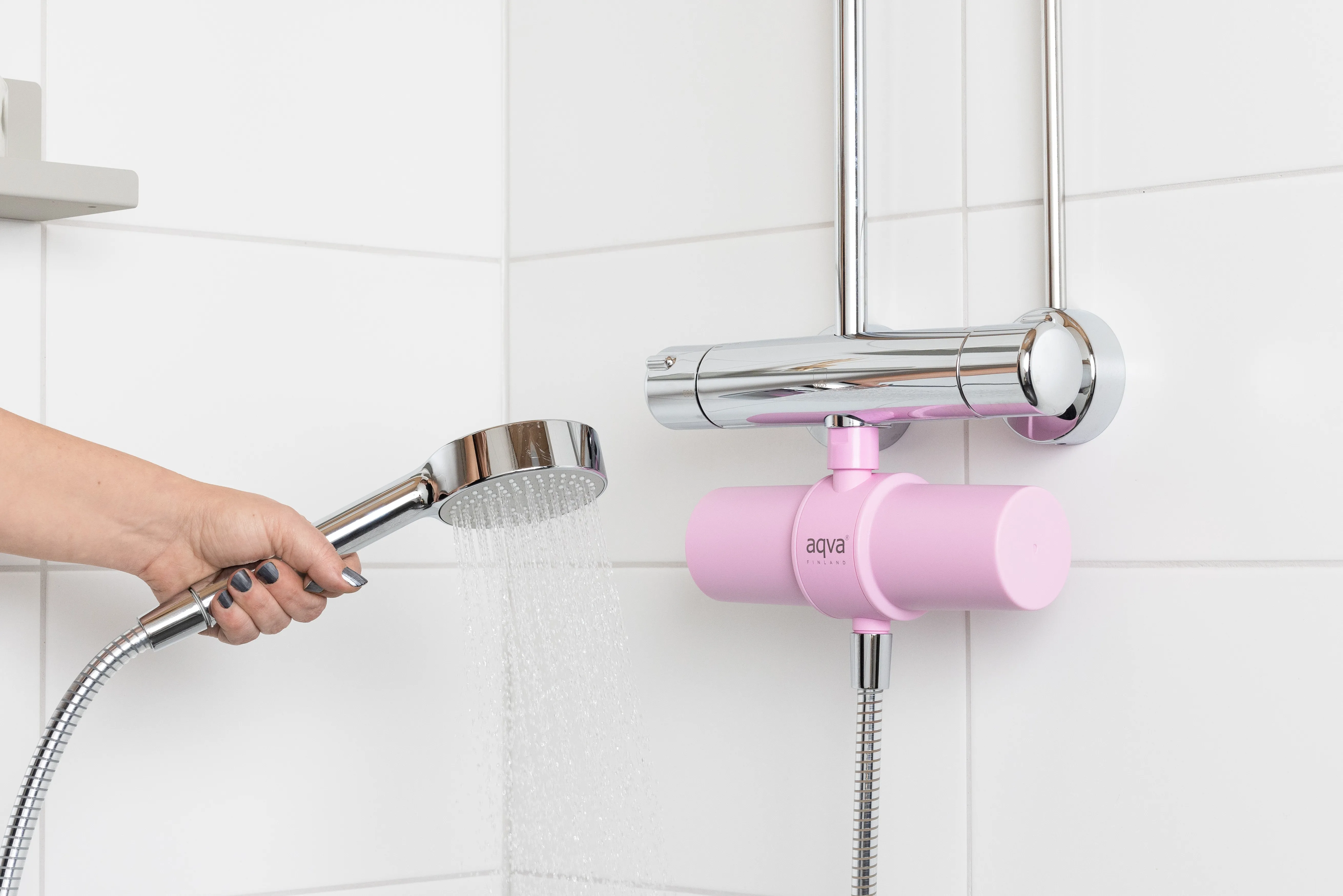
Christmas Gift Idea for a Beauty Lover
Finnish online shop


AQVA Finland
Open on weekdays 09–17
010 321 5080 (Mon–Fri, 10:00–15:00)
myynti@aqva.fi
Business ID: 2351337-8