Microplastics in Water


Are we drinking microplastics every day?
Microplastics and their existence were first discussed in Finland about fifteen years ago. At first, microplastics were part of studies conducted at an international level. However, there was also interest in Finland – could microplastics be found here? Research revealed that microplastics were and are present in Finland, also in nature and in waterways . Microplastics are created when plastic litter and waste that ends up in nature and waterways breaks down into smaller and smaller pieces. Over time, plastic turns into dust that is no longer visible to the naked eye.
There is so much microplastic in the world today that it ends up in the human body, for example, with food and drinking water. The water in Finnish cities and municipalities is mainly taken from open waters, which inevitably also end up with microplastic. The amount of microplastic that ends up in the body can be reduced by various means, one of which is filtering drinking and cooking water . In the current situation, where even our supposedly clean tap water can contain microplastics, filtering drinking water makes sense.
How do microplastics end up in waterways?
Washing machines
One of the biggest sources of microplastics is washing machines. Today, artificial fibers such as acrylic and polyester are increasingly used in clothing and textiles. Clothes and textiles made from synthetic materials release millions of plastic particles with every wash. The particles are so small that they fit through the filters of wastewater treatment plants, so they end up in rivers and seas. The amount of clothes and textiles that people own has also increased enormously. Together, these cause large masses of microplastics to end up in the environment and waterways.
Garbage thrown into nature
Another reason for microplastics found in nature is litter. In the past, recycling was not at the same level as it is today, and litter was often thrown into nature or dumped in open landfills. In some countries, a lot of plastic litter still ends up directly in the sea. Plastic litter thrown into nature or that ends up in nature begins to become brittle over the years. Natural conditions such as sunlight affect the litter, which becomes smaller and smaller over time, eventually becoming "dust" or microplastics. Litter and microplastics are carried everywhere, for example by animals and birds, including into waterways.
Wastewater treatment plants
In addition to washing machines and waste that ends up in nature, one source of microplastics is microplastics coming from wastewater treatment plants. This means microplastics coming from the municipal network, which come loose from the pipes or cosmetics. Cosmetics, such as scrubs that use exfoliating granules, contain microplastics. These microplastics have the same problem as the plastics coming from washing machines. They are so small that they can pass through the filters of wastewater treatment plants.
How do microplastics get into tap water and do they have any health effects?
This is a question that many are pondering. While wastewater treatment plants have been established, built and developed, not as much has been known about microplastics or their distribution. So not all of our wastewater treatment plants have been designed to handle the filtration of microplastics from drinking water. As previously mentioned, microplastics end up in waterways in several different ways. In Finland, water is taken from these waterways and is ultimately purified into drinking water from the tap. Although drinking water in Finland is of high quality and mostly very clean, not all microplastics can be purified from water with current purification plants. In addition, impurities are released from the pipes and end up in drinking water.
As microplastics are a relatively new phenomenon that has not been studied for decades, research into their potential health effects is only just beginning. Some studies have already detected microplastics in the lungs, for example. However, little can be said for sure about the effects of microplastics on health and the body. On the other hand, plastic softeners and BPA plastics, for example, are known to have effects on health, such as hormonal disruption. Filtering drinking and cooking water can prevent microplastics from entering the body, which is certainly not a bad thing given the current high exposure to microplastics.
Microplastics can be filtered from drinking water using various solutions. The most effective is reverse osmosis, which is the most thorough of the purification methods. A tap or table filter that can be easily and quickly installed on the tap also effectively filters microplastics.
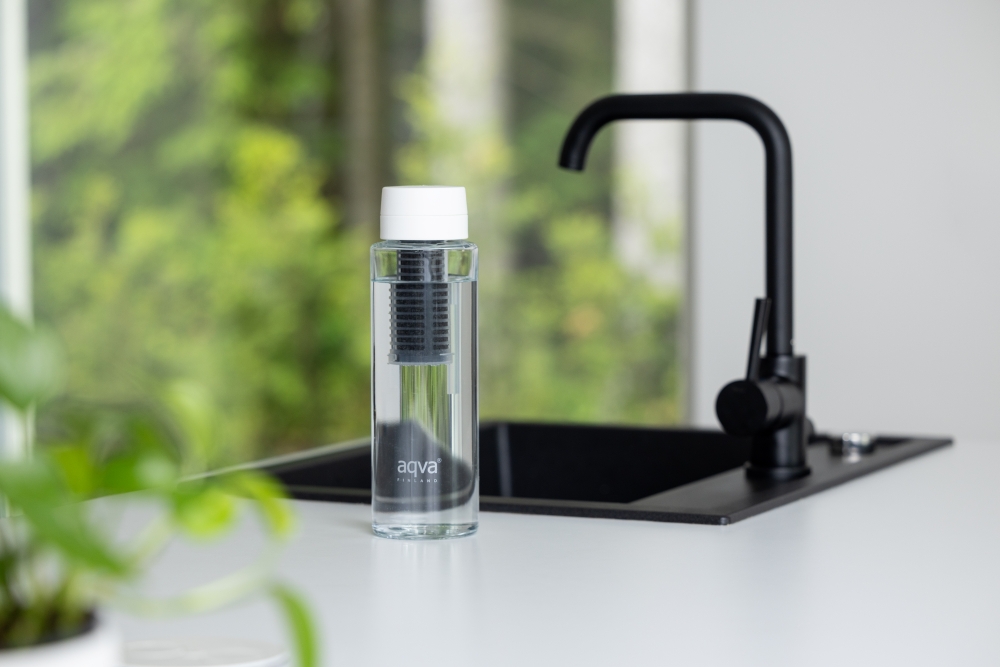
Filtered water bottle AQVA BOTTLE
Finnish online shop


AQVA Finland
Open on weekdays 09–17
010 321 5080 (Mon–Fri, 10:00–15:00)
myynti@aqva.fi
Business ID: 2351337-8